Two Ninja Legends Face Off | American Ninja Warrior
The air in Las Vegas is thick, not with the usual scent of desert heat and casino carpet, but with the electric charge of history. Under the neon-soaked lights, the goliath of steel known as Stage 3 looms. It is the gatekeeper, the great filter, the place where more than 99% of American Ninja Warrior dreams have evaporated.
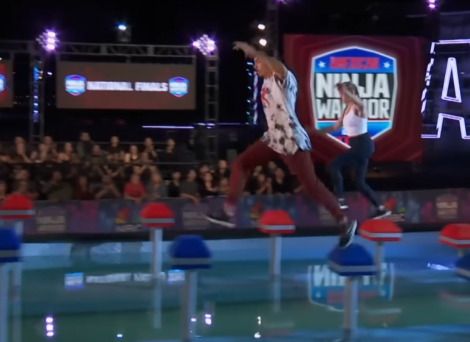
Tonight, only two athletes remain. It’s not a race, but something far more profound: a battle of style, era, and legacy. In one corner, the veteran. In the other, the prodigy. This is the face-off everyone has waited for.
The Analyst vs. The Comet
On the sideline, chalking his hands for what feels like the hundredth time, is Elias “The Anchor” Vance. A 12-season veteran, Elias was competing back when the obstacles were simpler and the athletes were just discovering what was possible. He’s a legend of the “old guard,” known for his methodical, powerful, and analytical approach. He doesn’t beat the course; he solves it. For Elias, Stage 3 is a personal demon. He has been here four times, and four times it has sent him home, his forearms screaming.
Waiting in the wings is Maya “The Comet” Chen. At 21, she represents the new breed of ninja. Raised in the era of specialized ninja gyms, her background is elite rock climbing, and it shows. She is whisper-light, dynamic, and possesses grip strength that seems supernatural. Where Elias is power, she is flow. She doesn’t just climb; she floats. This is her first time on Stage 3, and she carries the weightless confidence of youth.
Elias is running first.
The Run
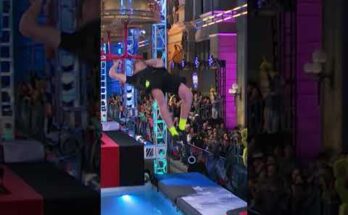
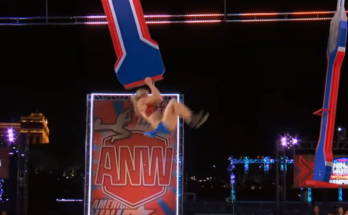
The buzzer sounds. Elias moves with his signature deliberation. He clears the “Patriot Pass,” his powerful frame stable on the spinning elements. He moves to “The Stinger,” a brutal laché-to-grab, and the crowd groans as he has to take an extra swing—a costly waste of energy.
He reaches the “Ultimate Cliffhanger.” This is where his journey ended two years ago. The 3.5cm ledges are infamous. He hangs, breathing. He moves one arm. Pauses. Moves the other. It is agonizingly slow, a portrait of pure, grinding determination. The burning lactic acid is visible in the shake of his legs. He makes the transition, his face a mask of pain, and lands on the platform with a roar.
He’s gassed. “Cane Lane” is all that’s left. He attacks it, but his forearms are gone. On the transition to the third cane, his grip finally fails. A split-second of failure, and he splashes into the water.
The arena is silent. He has set the bar.
The Face-Off
Now, it’s Maya’s turn. She doesn’t just know the benchmark; she saw the legend who set it fall.
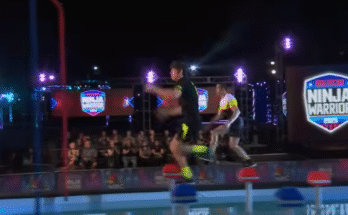
The buzzer sounds. Maya is a blur. She flies through “Patriot Pass,” linking moves Elias had to muscle. She hits “The Stinger” and, instead of pausing, uses her momentum in a flawless laché that looks effortless.
She arrives at the “Ultimate Cliffhanger” in half the time. She doesn’t pause. She doesn’t rest. Her climbing background takes over. She moves across the ledges with a rhythmic, terrifying speed, as if gravity simply likes her better.
She lands on the platform, breathing hard but visibly fresher than Elias. She looks at “Cane Lane.” Elias watches from the sideline, his face unreadable. Maya launches. Her grip is secure. She swings, transfers, and swings again. She completes the obstacle that took down the veteran.
Maya Chen didn’t just clear the obstacle; she cleared the legend. She didn’t win the million dollars—she timed out on the very next obstacle—but she had gone further.
As she climbed from the water, Elias was the first to meet her, pulling her into a tight embrace. It wasn’t a defeat; it was a passing of the torch. In the shadow of Mount Midoriyama, one legend’s pursuit had ended, and another’s had just begun.